The guide · The island's pantry · 5 min read
Ceylon tea explained, the regions and how to brew it
Ceylon tea is tea grown in Sri Lanka. Its seven regions, black and green, how to brew a pot, and how our house iced teas are made from syrups we cook here.
Ceylon tea is tea grown in Sri Lanka, most of it black, and its taste changes with the height of the hills it comes from: light and golden from the high country, dark and full from the low country of the south. Here are the seven regions, how to brew a pot, and how we turn tea into our house iced teas.
How did tea come to Sri Lanka?
By accident, almost. In the 1800s the island, then called Ceylon, grew coffee. In 1867 a Scottish planter, James Taylor, planted the first field of tea on the Loolecondera estate near Kandy. Two years later a leaf disease, coffee rust, struck the coffee plantations. By the late 1880s nearly all of them had been replanted with tea.
Today Sri Lanka is the world's fourth-largest producer of tea. The country changed its name in 1972, but the tea kept the old one. A lion on the packet is the mark of the Sri Lanka Tea Board: it means the tea inside is pure Ceylon tea, packed on the island.
What are the seven regions?
Tea is sorted here by height. The higher and cooler the estate, the lighter the cup. The Tea Board names seven regions.
High-grown, above 1,200 metres:
- Nuwara Eliya. The highest, at about 2,000 metres on average. The palest of Ceylon teas: golden and delicately fragrant.
- Dimbula. A golden-orange cup, mellow and refreshing.
- Uva. A remote district open to both monsoons, known for a smooth and aromatic tea.
- Uda Pussellawa. Next to Nuwara Eliya, but darker, with a tangy, medium body.
Mid-grown, between 600 and 1,200 metres:
- Kandy. Where it all began. A bright, coppery cup, strong and full.
Low-grown, from sea level to 600 metres:
- Ruhuna. The south, from the coastal plains up to the edge of the Sinharaja rainforest. A long, dark leaf and a full-flavoured cup.
- Sabaragamuwa. Dark with a reddish tint, and a hint of sweet caramel.
Ruhuna is our region. Its tea grows in the low hills behind this coast.
What is the difference between black and green tea?
They come from the same plant. The difference is what happens after picking.
For black tea, the leaves are withered, rolled and left in the air until they darken, then dried. That darkening gives black tea its colour, its strength and its malty taste. For green tea, the leaves are heated soon after picking, so they stay green and the taste stays light and grassy.
Sri Lanka makes mainly black tea, rolled in the traditional way. It also makes some green and white tea.
How do you brew a pot?
Black tea:
- Warm the pot with a little hot water, and pour it away.
- Use about one teaspoon of leaves, 2.5 g, for each cup.
- Pour on water that has just boiled.
- Wait three to five minutes. Shorter is lighter, longer is stronger and more bitter.
- Drink it plain, or with a splash of milk.
Green tea is more delicate. Let the boiled water stand for a few minutes, until it is around 70 to 80 degrees, and steep the leaves for two to three minutes. Boiling water makes green tea bitter.
Sri Lankans drink black tea in two ways: plain, often with a piece of jaggery to bite between sips, or as milk tea, strong and sweet.
How are our house iced teas made?
Each one starts from a syrup that our team cooks here, in small batches, so it is always fresh. The syrup is tea, sugar and one fruit or spice. Nothing comes from a bottle, and there is no flavouring. In the glass it meets ice, fresh lime and either still water or soda: you choose.
- Mango Iced Tea, 1,400 LKR. Fresh Colombo mango and Ceylon tea. Soft and fruity.
- Passion Fruit Iced Tea, 1,300 LKR. Fresh passion fruit and Ceylon tea, with lime and mint, topped with a spoon of the fruit, seeds and all.
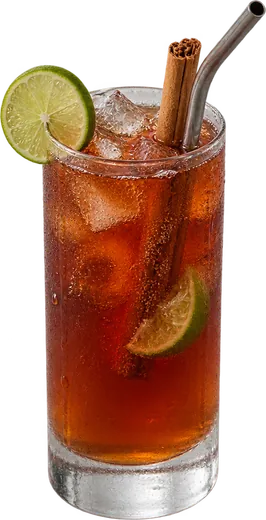
- Ceylon Cinnamon Iced Tea, 1,200 LKR. Strong Ceylon tea and cinnamon bark. Bright and warmly spiced.
- Lemongrass & Ginger Iced Tea, 1,200 LKR. Lemongrass, fresh ginger and green tea. Citrusy and cool.
- Iced Tea Jug, 3,600 LKR. One litre of any of them, to share, with four tall glasses.
Because they start from a syrup, our iced teas are sweetened. If you want tea with no sugar at all, order it hot.
The same cinnamon tea syrup gives a whisper of spice to the Twilight Fizz, 1,500 LKR, the mocktail that turns from blue to violet.
And hot tea?
- Ceylon Tea, 700 LKR. The island's own black tea, brewed in a warmed pot until deep and amber.
- Green Tea, 700 LKR. Brewed with water just below the boil, so it stays soft and fresh.
You can make either pot yours. For 300 LKR each we add fresh ginger, lemongrass, mint, a cinnamon stick, about five cracked cardamom pods, about ten cloves, a star anise, a spoon of honey or of kithul treacle, or a small jug of milk or coconut milk.
If the cinnamon caught your eye, read Ceylon cinnamon, true cinnamon. If you prefer a different cup, there is coffee in Hiriketiya and Dikwella. And the syrup that sweetens a Sri Lankan cup has its own page: what is kithul treacle.
Tea is only one part of what the island grows and how we cook it, and a cold jug in the middle of the table suits a long lunch by the sea.
Good to know
- Tea and iced tea are served all day, from 08:00 to 21:00, every day.
- Prices are in LKR, plus a 10% service charge. Filtered water is on the house.
- Every iced tea can be still or sparkling, at the same price.
- No alcohol is served.
- We are at Turtle Beach, Dikwella, less than five minutes by road from Hiriketiya.