The guide · The island's pantry · 5 min read
What is kithul treacle, Sri Lanka's palm syrup
Kithul treacle is the boiled sap of Sri Lanka's fishtail palm. How it is tapped, how it differs from maple syrup and jaggery, and where it is on our menu.
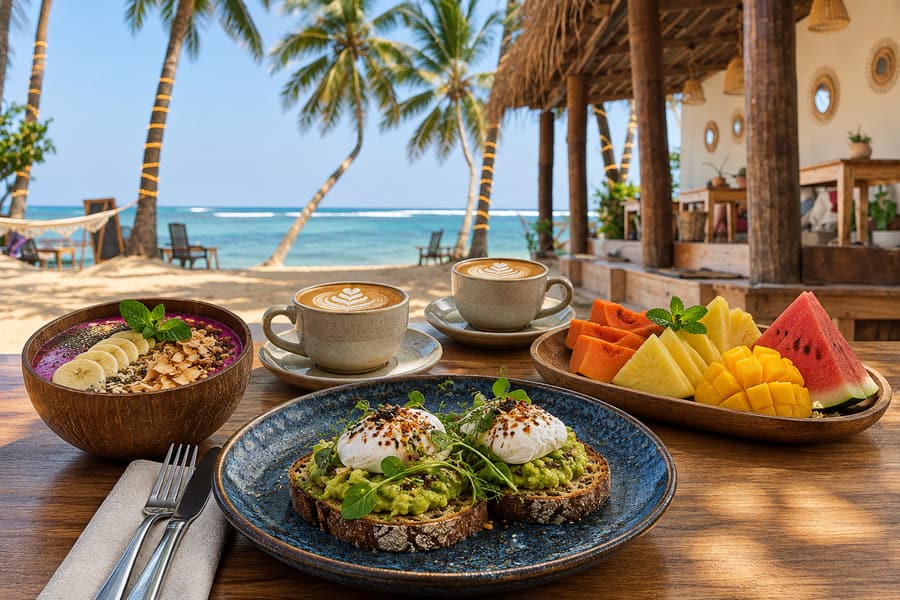
Kithul treacle is the sap of the fishtail palm, tapped from the flower of the tree and boiled over a wood fire until it turns into a dark syrup you can pour. It tastes of caramel and dates with a little smoke, and Sri Lanka pours it over curd, pancakes and almost anything sweet.
Which tree does kithul come from?
The kithul palm, Caryota urens, grows in Sri Lanka and also in India, Myanmar and Malaysia. In English it is the fishtail palm, because each leaflet is ragged at the end like the fin of a fish. It can reach about 18 metres.
On the island it likes the wet and the middle country: the Southern, Central, Sabaragamuwa and Uva provinces. It is a slow tree. A palm can take up to 15 years before it flowers, and it flowers only at the end of its life. The clusters come one after another, from the top of the trunk down, and when the last one has fruited the tree dies. So every bottle of treacle comes from a short season at the end of a long wait.
How is the sap tapped?
Not from the trunk, as with maple, but from the flower. The work is called kithul madeema, and it is an old craft handed from one generation to the next.
- The tapper climbs the palm, often ten metres or more, on a ladder of wood or bamboo tied to the trunk.
- He prepares the young flower cluster. A mixture of herbs and spices, which differs from village to village, is put on the cut to keep the sap running.
- A thin slice is cut from the end of the flower, and a pot is hung under it.
- The pot is emptied about twice a day, morning and afternoon.
In some villages the first flower of a tree is left alone as an offering, which also lets the palm set seed.
Fresh sap is thin and sweet. Left to itself it ferments quickly into toddy. For treacle it goes straight to the fire.
How does sap become treacle, and what is jaggery?
The sap is boiled over a wood fire for hours, until most of the water has gone. What is left has about the colour and thickness of dark honey. That is kithul pani, the treacle.
Boil it longer and it sets. Poured into moulds, often half coconut shells, it hardens into hakuru, kithul jaggery: a brown block of raw palm sugar. Sri Lankans often take a bite of jaggery with a sip of plain tea, in place of stirring sugar into the cup.
A good treacle has nothing added. That is also its problem. There are fewer skilled tappers than there were, and more people who want the syrup, so some bottles on the market are stretched with cane sugar or water. If you want to take one home, buy from a shop or a maker who can tell you where it was tapped.
How is kithul different from maple syrup, honey or molasses?
- Maple syrup is also boiled tree sap, but it comes from the trunk of a tree in a cold country. Kithul comes from the flower of a palm in the tropics. It is darker and deeper: woody, a little smoky, close to dates.
- Honey is made by bees. Kithul is only a plant, so vegans can pour it.
- Treacle and molasses in Europe are what is left over when cane sugar is refined. Kithul treacle shares the name and little else. It is the whole sap, boiled down.
- Jaggery in much of South Asia is made from sugar cane. Kithul jaggery is made from this palm.
Kithul has a long place in Ayurveda, and many people think of it as a kinder sweetener. We like it for the taste. It is still sugar, and it is food, not medicine.
Where is kithul on our menu?
Almost everywhere something is sweet. Kithul sweetens a great deal of this menu, and ours comes from Badulla, near Ella, in Uva, one of the provinces where the palm grows.
On the plate, at breakfast:
- Kithul Waffles, 2,100 LKR. Hot from the iron, deep golden and crisp, with kithul treacle, a scoop of vanilla ice cream and a dust of cinnamon.
- American Pancakes, 2,400 LKR. A soft stack under the season's fruit, with kithul poured over in place of maple.
- Papaya Curd Bowl, 2,300 LKR. Buffalo curd in half a papaya with our granola, coconut, lime and mint, and treacle to finish. Curd and treacle is the island's own dessert, and it has an article of its own.
- Tropical Smoothie Bowl, 3,200 LKR. The granola on top is baked here with kithul, oats, coconut and cashews.
In the glass:
- Watermelon Lemonade, 1,900 LKR. Ripe watermelon, basil seeds, lime, soda and kithul.
- Coconut Cold Brew, 1,500 LKR. Cold brew shaken hard with coconut milk, kithul and coconut ice cubes.
- Mango Lassi, 1,900 LKR. Sri Lankan curd and ripe mango with a ribbon of kithul.
- Date & Almond Shake, 2,400 LKR. Dates, banana, almonds and cold milk, with a spoon of kithul for a caramel finish.
It also sweetens our three Ayurvedic shots, the peanut butter we grind here and the citrus dressing of the Tuna Tiradito. And you can add it yourself: 30 ml of kithul treacle, about two tablespoons, is 300 LKR beside any coffee, tea, bowl or dessert.
The jaggery in our Milk Rice and in the Ashwagandha Moon Milk is the solid cousin: it is kithul jaggery too.
Kithul is one small part of what the island grows and how we cook it. If you like knowing what is in your glass, read about king coconut and true Ceylon cinnamon next.
Good to know
- Waffles, pancakes and bowls are on the breakfast menu, served from 08:00 to 11:00. The Papaya Curd Bowl is also a dessert at lunch and dinner, from 11:00 to 21:00.
- Prices are in LKR, plus a 10% service charge. Filtered water is on the house.
- Tell us about any allergy: ours is one shared kitchen.
- We are at Turtle Beach, Dikwella, less than five minutes by road from Hiriketiya.