The guide · The island's pantry · 5 min read
King coconut explained, Sri Lanka's orange thambili
King coconut, or thambili, is the orange drinking coconut native to Sri Lanka. How it differs from a green one, how to drink it, and our drinks with it.
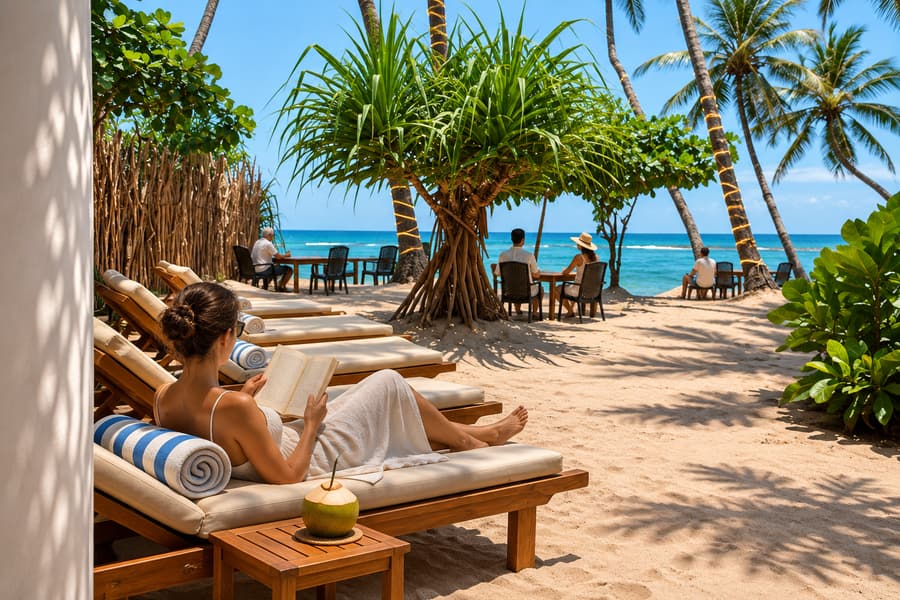
King coconut, called thambili in Sinhala, is a variety of coconut native to Sri Lanka with a bright orange skin, grown for its sweet water and not for cooking. You drink it fresh from the nut at a roadside stall, or at Ohana poured over ice for 800 LKR.
What is a king coconut?
It is a coconut, the same species as the brown one in a kitchen, but a variety of its own. Botanists call the variety aurantiaca, after its orange colour. Sri Lanka is its home, and it is also found in India and Indonesia.
The palm is shorter than the tall coconut palm that gives the island its oil and its coconut milk. The nuts hang in heavy bunches, smooth and orange. There are several kinds of thambili: some small, one with a pink layer under the skin, one shaped like a bottle.
How does it differ from a green coconut?
- The colour. A king coconut is orange from the start. A green drinking coconut is an ordinary coconut picked young, at the stage Sri Lankans call kurumba.
- The use. An ordinary coconut has two lives. Young, it is drunk. Left to ripen, it gives the flesh, the milk and the oil that Sri Lankan cooking stands on. A king coconut is grown for its water. Nobody waits for one to ripen for a curry.
- The taste. Most people find the water sweeter and lighter than the green kind, clean and a little floral, with less of the nutty, salty edge.
What is in it is simple: water, natural sugars, minerals, mainly potassium, and some B vitamins and vitamin C.
How do you drink one?
At the roadside you will see them before you see the stall: stalks of orange nuts hanging from a frame or piled on the ground.
- Choose and point. Ask for a cold one if the stall has a cooler, or take one from the shade.
- Let the seller open it. The top comes off in a few strokes of a heavy knife. It is quick, and it is not a job for a visitor.
- Drink it there. Usually with a straw, or straight from the opening if you would rather skip the plastic.
- Hand it back. The seller splits the empty nut and cuts a small scoop from the shell, so that you can eat the thin layer of soft, jelly-like flesh inside. Many visitors miss this part.
A king coconut does not travel well once it is open. It is a drink for where you are standing.
Why is it everywhere on the island?
Because it suits the place. The variety is native here, and the palms are part of the landscape. Each one is its own sealed bottle: no fridge, no factory, no label. And in a hot country, something cool, clean and gently sweet at every corner is worth a great deal. Sri Lanka now packs king coconut water and sends it abroad too, but the roadside nut is still the real thing.
Tradition has a hand in it as well. In Ayurveda, tender coconut water is considered cooling, the drink for the hot hours and for coming in from the sun, and Sri Lankan households have long used thambili in home remedies. We tell you this because it is part of the island's story. It is a drink, not medicine.
Which drinks on our menu use king coconut?
More than the one with coconut in its name.
- Coconut Water, 800 LKR. The water of the golden king coconut, poured over ice. We serve it in a glass, not in the whole coconut.
- After Sun, 1,700 LKR. Cucumber pressed to order with king coconut water, lime and mint, over coconut ice cubes. Pale green, cool and light, for coming in off the sand.
- Pitta Cooler, 2,400 LKR. Coriander and fennel seeds steeped in king coconut water, poured over ice with fresh mint, lime and basil seeds. Ayurveda calls the body's heat pitta, and this is the tall glass named after it.
- Focus Shot, 1,200 LKR. 60 ml of gotukola blended with king coconut water, mint and ginger. It is also the middle glass of The Ohana Ritual, 3,300 LKR, our three Ayurvedic shots on a wooden board.
- Coconut ice cubes. We freeze coconut milk and king coconut water into cubes. They go into the After Sun, the Coconut Cold Brew, 1,500 LKR, the Blue Lagoon Latte, 1,500 LKR and the Blue Tide Matcha, 1,600 LKR.
You can read more about the herbs in those glasses in gotukola explained and in Ayurvedic drinks, explained simply. The palm syrup that sweetens several of them has its own page: what is kithul treacle.
When is the right moment for one?
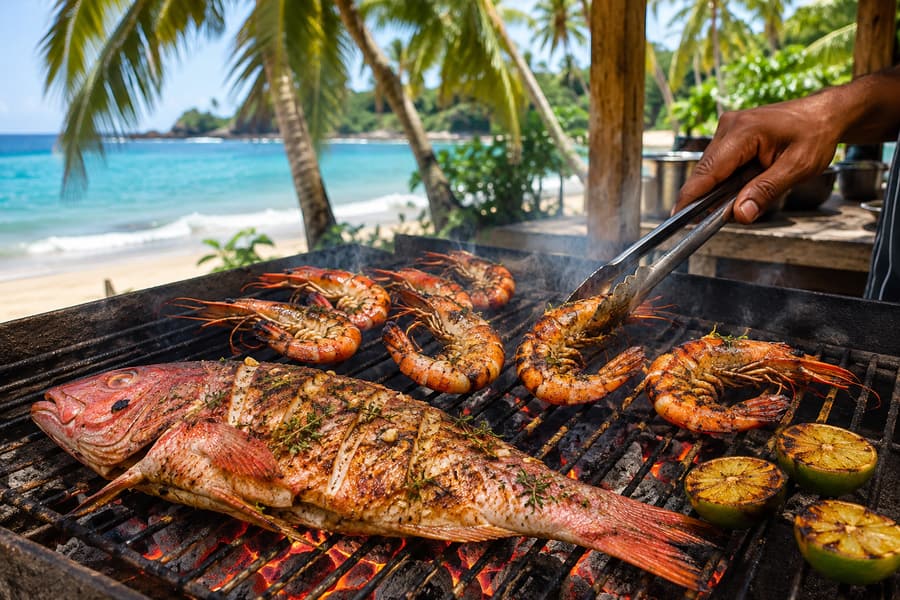
Any hot moment. After a swim or a snorkel on the reef, when you are salty and thirsty. At midday on a sunbed, when coffee feels like too much. And at the table, beside grilled fish, where its light sweetness sits well with lime and salt.
King coconut is one of the things this island grows that needs nothing done to it. The rest of what the island grows and how we cook it takes a kitchen. This one only takes a knife and some ice.
Good to know
- Coconut Water, the coolers and the Ayurvedic elixirs are served all day, from 08:00 to 21:00. Iced coffee and matcha are served until 18:00.
- Prices are in LKR, plus a 10% service charge. Filtered water is on the house.
- Sunbeds are free for the whole day, one for each person, when each person spends 10,000 LKR on food and drinks; otherwise they cost 1,000 LKR an hour each. A towel comes with every sunbed.
- No alcohol is served.
- We are at Turtle Beach, Dikwella, less than five minutes by road from Hiriketiya.