The guide · Turtles and the bay · 5 min read
Turtle Beach Dikwella, also called Turtle Point, a guide
Where Turtle Beach in Dikwella is, why wild sea turtles feed and nest there, what a visit is like, when to come and how to behave near the turtles.
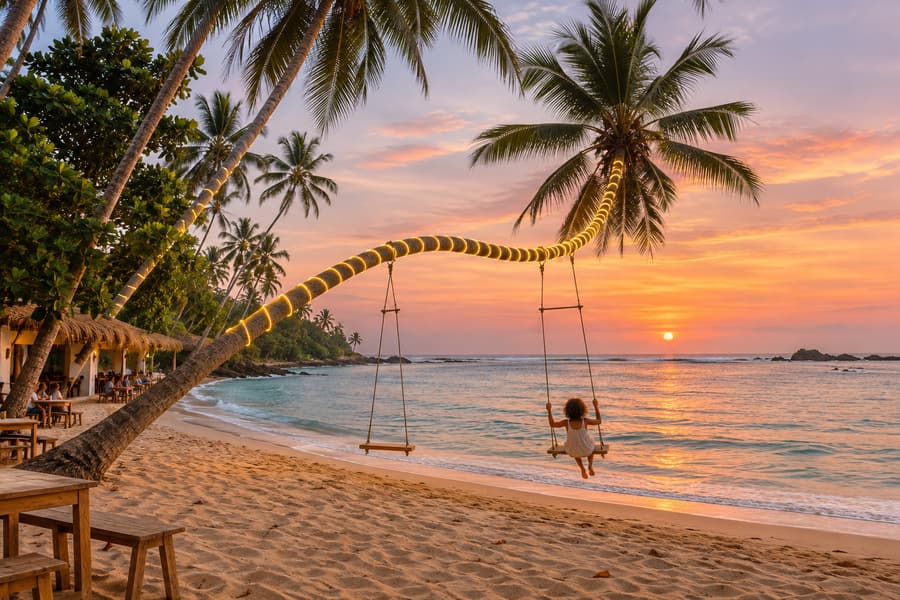
Turtle Beach is a calm, round bay in Dikwella on the south coast of Sri Lanka, less than five minutes by road from Hiriketiya, where wild sea turtles feed on the reef. Many people search for it as Turtle Point, and Ohana Beach Club & Restaurant is on its sand.
Where is Turtle Beach, and is it the same as Turtle Point?
Turtle Beach is on the quiet side of Dikwella, in the area called Batheegama. The road from Hiriketiya takes less than five minutes. Directions are on Find us.
The two names are for the same place: Turtle Point is our bay, and most people also call it Turtle Beach. Travel writers describe the area as much quieter than Hiriketiya or the town beach.
One warning about the name: there is another Turtle Point at Mirissa, about an hour to the west. If a map sends you towards Matara and beyond, it has chosen the wrong one.
Why do turtles come to this bay?
Because there is food and there is shelter. A reef lies across the mouth of the bay, on the horizon when you sit on the sand. It breaks the swell, and things grow on and around it. Grown green turtles eat sea grass and algae, so a reef with plenty of growth keeps them coming back.
Families of sea turtles live in the bay. The ones seen here are most likely green turtles, the kind seen most often around Sri Lanka. Counts by the wildlife department at Rekawa, the big nesting beach further east, show green turtles far ahead of every other kind on this coast.
The bay is also a nursery. Turtles often come up our beach at night to lay their eggs. We keep our stretch of sand clean, tidy and as gentle a slope as the sea allows, so that a turtle can climb it easily. On nesting nights we turn our lights off and move the sunbeds back from the water's edge. Next to us, Gayan keeps a turtle protection centre. He has lived here for many years. He collects the eggs laid in the area so that nobody takes them to sell or to eat, and releases the hatchlings to the sea.
What is a visit like?
Slow. That is the honest answer. Nobody runs a show here, and the turtles keep no timetable.
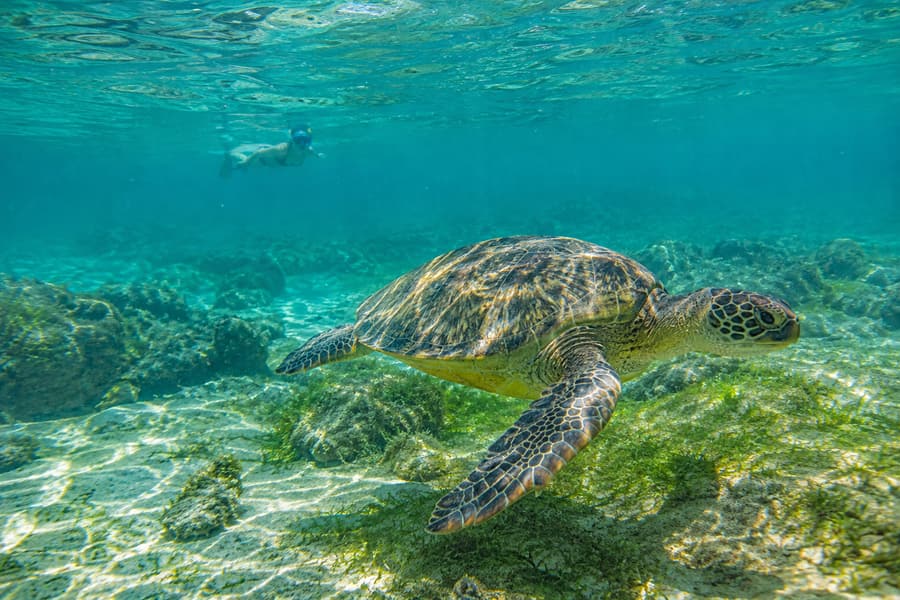
You walk into the water where the sand is clear, with a mask. We lend masks free, ask at the bar. Then you float and you watch. A feeding turtle comes up to breathe every few minutes. A small dark head that lifts, breathes and goes down again is a turtle. Some guests see one in ten minutes. Some see none all day and see two the next morning. They often feed only a few metres from the beach, and we see them most early in the morning and at sunset.
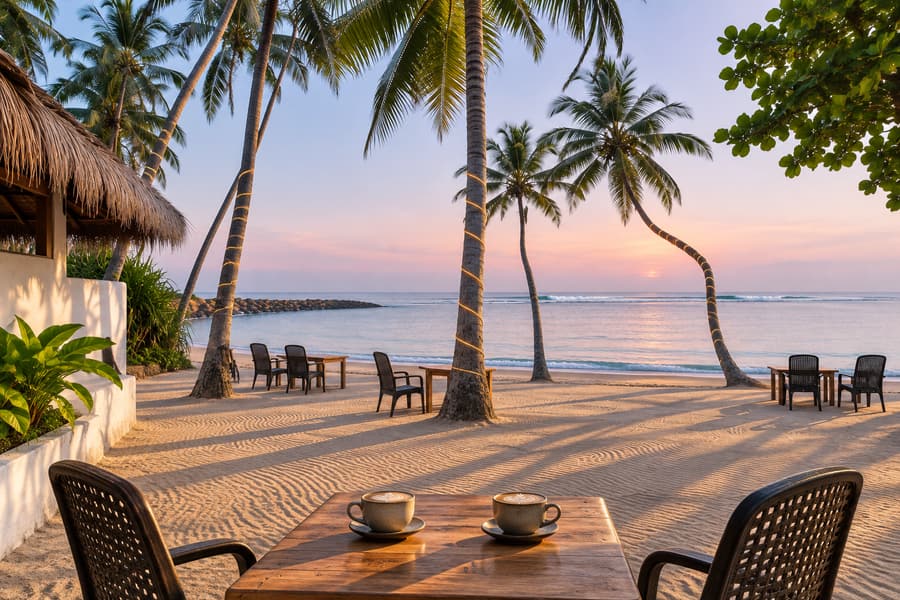
Many guests never put a mask on. They watch the bay from a sunbed or a swing under the palms and see a head come up between two sips of coffee.
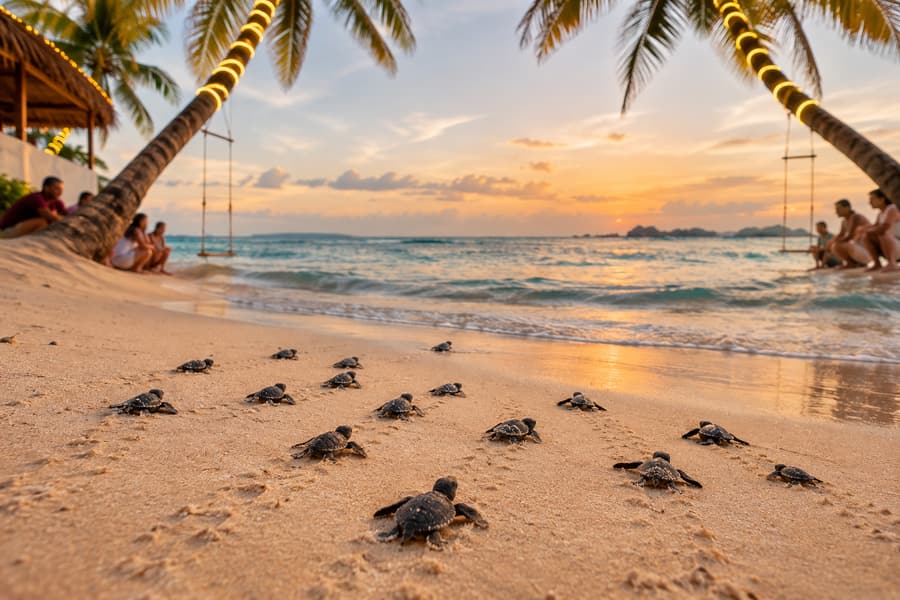
Late in the day there is sometimes another thing to see. If you are lucky, a release of hatchlings happens at Ohana or beside it, between our two palms, between 17:00 and 19:00, and we turn our lights off for it. It cannot be promised or booked. It happens when the hatchlings are ready. We wrote about it in turtle hatchlings in Dikwella.
How should you behave here?
The bay is the turtles' home before it is our swimming place. Sea turtles and their eggs are protected by law in Sri Lanka. The rules are short:
- Never touch a turtle. Not the shell, not the flippers.
- Never chase. If it swims away, let it go.
- Never feed. Turtles find their own food.
- Keep your distance, and never swim right above one. A turtle must reach the surface to breathe.
- Do not stand on the reef. It is alive, and it is where they eat.
- At a hatchling release: nobody touches or lifts a hatchling, no flash, and nobody stands between them and the water.
Sea urchins live in the rocks around the bay. They do not come to you, but their spines are sharp. Walk in where the sand is clear, and once you are near rocks, float and keep your feet up.
The longer version, with what conservation groups say about distances, is in how to swim with turtles near Hiriketiya.
When is a good time to come?
The sea on the south coast is usually calmer from about December to April. From about May to September the south-west monsoon brings rougher water, and rough water is cloudy water, so in those months swim only on calm days. If waves are breaking hard over the reef, it is a day for the sand and not for the mask.
Flat water matters more than the month. Many snorkellers like the early morning, before the wind gets up. Breakfast is served from 08:00, so the two go well together.
Who is this beach for?
It suits families, couples of every age, and people who want a quiet day. The bay is away from big waves, tuk-tuks and crowds. It is not a surf beach, and it is not a party beach. Ohana serves no alcohol. For surf lessons and music in the evening, Hiriketiya is less than five minutes away and does those things well.
The bay itself is public. Ohana has its own private stretch of beach inside its grounds, in front of the bay, with sunbeds, hammocks, a cabana and two swings under the palms. More about Turtle Beach and swimming with its turtles is on our turtles page.
Good to know
- Ohana is at Turtle Beach, Dikwella, less than five minutes by road from Hiriketiya.
- Snorkel masks are lent free. Ask at the bar.
- Breakfast is served from 08:00 to 11:00, lunch and dinner from 11:00 to 21:00, every day. Prices are in LKR, plus a 10% service charge.
- Sunbeds are free for the whole day, one for each person, when each person spends 10,000 LKR on food and drinks; otherwise they cost 1,000 LKR an hour each. A towel comes with every sunbed.
- A hatchling release can never be promised or booked. If you are lucky, it happens between 17:00 and 19:00.