The guide · Turtles and the bay · 5 min read
Turtle hatchlings in Dikwella and what a good release is
How sea turtles nest around Dikwella, why eggs are protected, what a careful hatchling release looks like, and how to behave if you are lucky to see one.
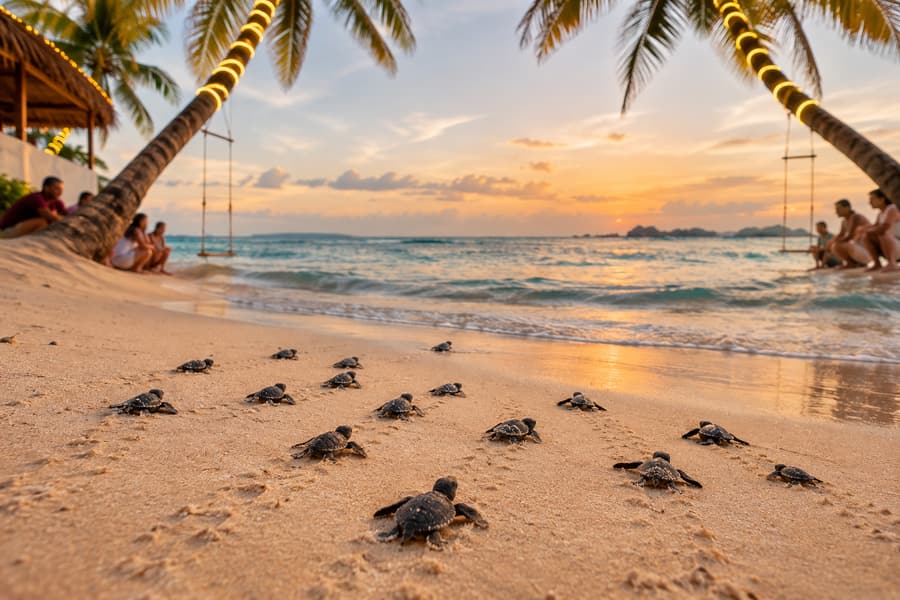
Sea turtles nest on the beaches around Dikwella, and beside Ohana a neighbour protects the eggs and releases the hatchlings to the sea. If you are lucky, a release happens at Ohana or next to it around sunset, but it can never be promised or booked.
How do sea turtles nest on this coast?
Five kinds of sea turtle nest in Sri Lanka: green, olive ridley, hawksbill, loggerhead and leatherback. They nest through the whole year, with busier months in the first half of it.
A female comes ashore almost always at night. She climbs above the tide line, digs a hole with her back flippers, lays her eggs, covers them and goes back to the sea. A nest holds around a hundred eggs. The warm sand does the rest for about seven to nine weeks. The heat of the sand also decides the sex: warmer nests give more females, cooler nests more males.
The hatchlings usually come out at night and walk towards the brightest horizon, which on a dark beach is the sea. Very few of them will grow old, which is why every nest counts.
Families of sea turtles live in our bay, and turtles often come up our beach to lay their eggs. We keep our stretch of sand clean, tidy and as gentle a slope as the sea allows, so that a turtle can climb it easily.
Why are the eggs collected and protected?
Because people take them. Turtles and their eggs are protected by law in Sri Lanka, yet for many years eggs on the south coast have been dug up to be sold or eaten. Researchers have written that on some stretches nearly every nest was robbed.
Conservation bodies agree on the order of things. First choice: leave the nest where the turtle made it, and guard it. Moving eggs to a protected place is the second choice, for nests that cannot be kept from harm where they lie.
Next to Ohana there is a turtle protection centre, kept by Gayan, who has lived here for many years. He collects the eggs laid in the area so that nobody takes them to sell or to eat. He lets them hatch in a clean, protected place. When the hatchlings are ready and strong, he releases them to the sea on a beach sheltered by the reef, where more of them have a chance. He releases them between 17:00 and 19:00, as the light goes.
What is the debate about hatcheries in Sri Lanka?
Sri Lanka has many turtle hatcheries, and a lot of them live from visitors. Researchers and conservation groups have criticised the same things for years:
- Tanks. Hatchlings are kept in water for days, sometimes much longer, so that visitors can see them. A hatchling is born with a small store of energy for the swim out to sea. Days in a tank spend it.
- Handling. Visitors hold hatchlings and young turtles for photographs.
- Bought eggs. Paying collectors for eggs can make more people dig for them.
- Permits. A hatchery needs permission from the Department of Wildlife Conservation, and a study found that those it visited did not know this.
The other side is also true. Researchers say that closing every hatchery would not work on a coast where eggs are taken, and that one run with care can help. So the word "hatchery" tells you little. What a place does with its hatchlings tells you everything.
What does a good release look like?
The advice written for the countries around the Indian Ocean is clear:
- Promptly. Hatchlings go to the sea as soon as possible after they come out of the nest. They are not kept back for a show.
- At dusk or in the dark. Not in the heat of the day, when the sand burns and predators are watching.
- On their own. They are set down on the sand and walk to the water themselves. That walk is believed to help them know this beach again, years later.
- No hands. Nobody picks one up, not even to help.
- No flash, no bright lights. Light pulls them the wrong way.
- No tanks of young turtles kept for visitors.
Anywhere in Sri Lanka, ask before you pay: how long are hatchlings kept, and may visitors hold them? If the answer is "days" or "yes", walk on.
If you are lucky: a release at Ohana
With some luck, a release happens at Ohana or beside it, between our two palms, between 17:00 and 19:00. We turn the restaurant's lights off for it. Guests sit at their table and watch the hatchlings find the sea by instinct.
We cannot promise it and you cannot book it. It happens when the hatchlings are ready. Come for the evening. A release is a gift.
If it happens while you are here:
- Nobody touches or lifts a hatchling.
- No flash. Hold your phone low and still.
- Nobody stands between them and the water. Keep children beside you.
- Stay quiet. Let the moment be theirs.
The grown turtles of the bay have their own rules, on our turtles page and in how to swim with turtles. The evening itself is on Sunset & Dinner.
Good to know
- Ohana is at Turtle Beach, Dikwella, less than five minutes by road from Hiriketiya.
- A release cannot be reserved. It happens between 17:00 and 19:00, if you are lucky, with our lights off.
- Lunch and dinner are served from 11:00 to 21:00. Prices are in LKR, plus a 10% service charge.
- Never touch, chase or feed a turtle, in the water or on the sand.