The guide · Turtles and the bay · 5 min read
Sea turtles of Sri Lanka, the five species and the law
The five sea turtles nesting in Sri Lanka, how to tell them apart in the water, which ones you may meet on the south coast, and how the law protects them.
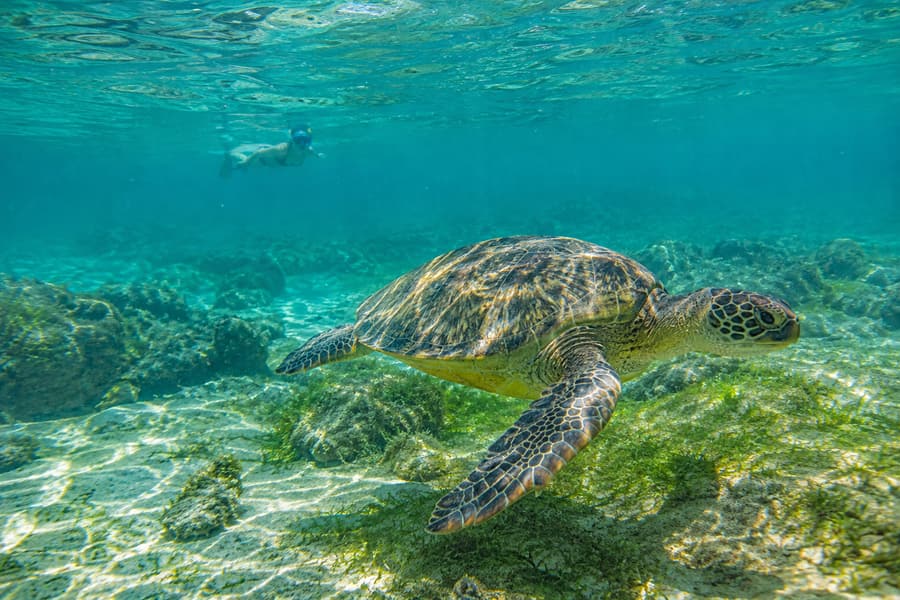
Five of the world's seven kinds of sea turtle nest in Sri Lanka: the green, the olive ridley, the hawksbill, the loggerhead and the leatherback. On the south coast the one you are most likely to meet is the green turtle, and all five are protected by law.
Which five sea turtles live around Sri Lanka?
- Green turtle. The one seen most often near the shore. Grown green turtles eat sea grass and algae, so they stay around shallow bays and reefs where these grow. The shell of an adult is longer than 80 cm.
- Olive ridley. A small turtle with an almost round shell, dark grey to dark green. It is the kind that nests most in some places further east, such as Bundala.
- Hawksbill. A turtle of the coral reef, with a narrow, pointed beak like a bird's and a shell of amber, brown and black. The plates of its shell overlap like roof tiles.
- Loggerhead. Named for its big head and strong jaws. It nests in Sri Lanka only now and then.
- Leatherback. The largest sea turtle in the world. It has no hard plates on its back. Its shell is dark and leathery, with long ridges from head to tail and pale spots.
How do you tell them apart in the water?
You will not have much time, and you should not go closer to get it. Three questions do most of the work. They follow the identification key used by the Olive Ridley Project, a turtle conservation charity.
- Is the back hard or leathery? A dark, leathery back with ridges is a leatherback. Every other kind has hard plates.
- What is the face like? A sharp beak like a bird's is a hawksbill. A short, rounded face is a green turtle. A very large head, wide like a triangle, is a loggerhead.
- How many big plates run down each side of the shell? Four means green or hawksbill. Five means loggerhead. Six or more, on a small round shell, means olive ridley.
For most visitors on this coast the real question is only "green or hawksbill?". Look at the face and at the back edge of the shell. A green turtle is smooth and rounded. A hawksbill has the beak, and the back edge of its shell is toothed like a saw.
A photo taken from a distance is enough to check later. Do not follow a turtle to count its plates.
Which ones will you see on the south coast?
Mostly green turtles. The wildlife department counts the turtles that come ashore to nest at Rekawa, near Tangalle. In its figures for 2020 to 2022, green turtles came ashore several thousand times. Olive ridleys were counted fewer than a hundred times in the same three years, and leatherbacks only a handful of times. Further east, at Bundala, the picture turns around and the olive ridley is the common one.
In the water it is the same story. The turtles that feed close to shore in bays like ours, Turtle Beach in Dikwella, are most likely green turtles, because their food grows in the shallows. A hawksbill is possible wherever there is reef, and it is a good day when you see one. Olive ridleys, loggerheads and leatherbacks live further out, and people meet them mainly at night on a nesting beach.
Wild sea turtles often feed on the reef in front of Ohana. Nobody can promise you one, but you can read where to swim with turtles near Hiriketiya to give yourself the best chance.
How does the law protect them?
All five kinds are protected under Sri Lanka's Fauna and Flora Protection Ordinance. The Department of Wildlife Conservation is the body that holds the legal authority, as it says in its own report to the regional turtle agreement. Researchers who have written about the law sum it up like this:
- It is against the law to catch, kill, injure or keep a sea turtle.
- It is against the law to take, keep or sell the eggs.
- It is against the law to sell turtle products, such as shell.
- A turtle hatchery needs the permission of the wildlife department.
Trade in sea turtles between countries is also restricted under CITES, the international agreement on trade in wild species. So a comb or a bracelet of real tortoiseshell is not a souvenir. It is a problem at the airport, and before that for a hawksbill.
Laws and penalties are changed from time to time. If you plan anything more than watching, for example research, filming or volunteering, ask the Department of Wildlife Conservation and check before you travel.
What does this mean for a visitor?
Very little effort, in fact. Watch, and leave things as they are.
- Do not touch, chase or feed a turtle, in the water or on the sand.
- Do not buy turtle eggs, meat or shell, and do not eat them if offered.
- If you find a nest or a turtle on a beach at night, keep away, keep lights off, and tell the people who look after that beach.
- Be careful with places that keep turtles in tanks for visitors to hold. A hatchling belongs in the sea as soon as it is ready.
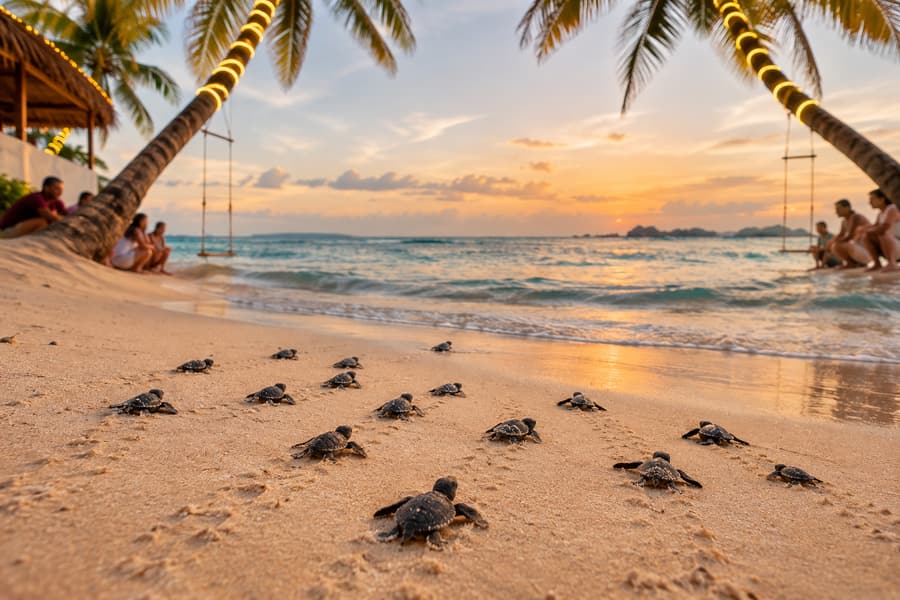
Next to Ohana, Gayan keeps a turtle protection centre. He collects the eggs laid in the area so that nobody takes them to sell or to eat, and he releases the hatchlings to the sea. There is more about the bay on our page about Turtle Beach and its turtles.
Good to know
- Ohana is at Turtle Beach, Dikwella, less than five minutes by road from Hiriketiya.
- Wild sea turtles often feed on the reef of the bay. Snorkel masks are lent free, ask at the bar.
- Never touch, chase or feed the turtles.
- Sea urchins live in the rocks. Walk in where the sand is clear.
- We are open every day. Breakfast is from 08:00 to 11:00, lunch and dinner from 11:00 to 21:00.