The guide · Working by the sea · 5 min read
A digital nomad guide to Hiriketiya and Dikwella
An honest guide to working remotely from Hiriketiya and Dikwella, with internet and SIM cards, power cuts, where to work and stay, costs and visas.
Yes, you can work remotely from Hiriketiya and Dikwella, and many people do, mostly from December to April. The internet is good enough for most jobs if you carry a backup, the power sometimes goes, and the sea is a few steps from the desk. Here is what to expect, without the gloss.
How is the internet, and do power cuts still happen?
Better than its reputation, and still not a city connection. Two things are true together.
- Mobile data is strong. At the end of 2025 the median mobile download speed in Sri Lanka was about 46 Mbps and the median fixed line about 32 Mbps, according to Ookla's figures in the Digital 2026 report. Those are national numbers, not a promise for one village.
- Wi-Fi depends on the house. A guide for remote workers, updated in June 2026, says many colivings and coworking rooms now have fibre, while cafes are still catching up. Ask your host for a speed test before you book a month.
So the working habit on this coast is simple: Wi-Fi first, your phone as a hotspot second. A local SIM costs little, and you buy it with your passport in a few minutes. The details are in internet and SIM cards in Sri Lanka.
As for the power, the long daily cuts of 2022 are behind us, but the grid still fails now and then. In February 2025 a fault was followed by scheduled cuts across the whole island. The same June 2026 guide speaks of a cut of a few hours once or twice a month on the south coast, usually announced, and of short ones in bad weather.
What it means for you:
- Keep the laptop and a power bank charged.
- Ask your accommodation if it has a generator or a battery.
- Remember that when the power goes, the Wi-Fi router goes with it. Your phone does not.
Where do people work?
There is no big coworking building here. Work happens in three kinds of places.
- Colivings. Houses with rooms, desks and a shared work room, such as Slow Life Coliving by Nomadico or HomeBase Coliving in Hiriketiya. They suit a stay of a week or more.
- Cafes and hostels with a work corner. Dots Bay House on the beach has a coworking area, and MOND is known as friendly to laptops.
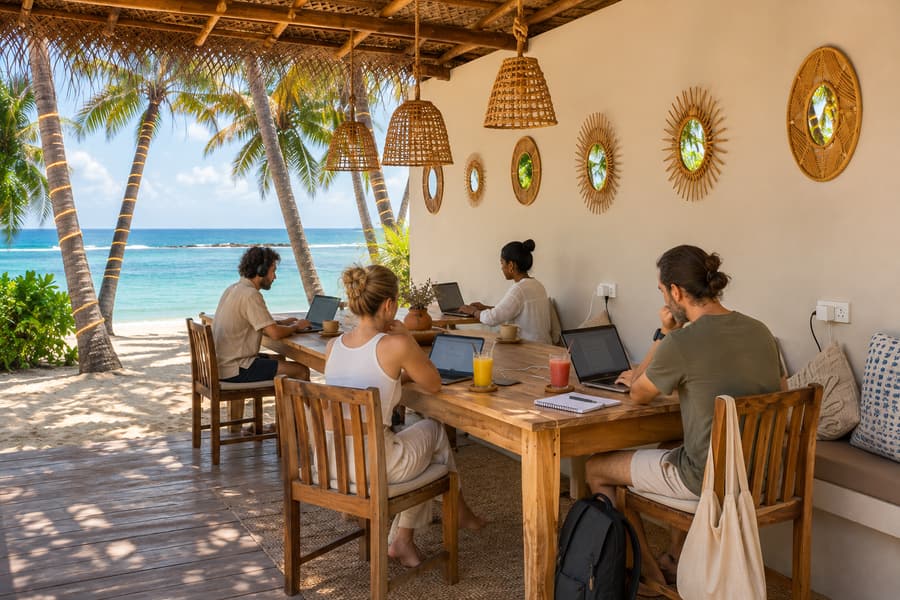
- By the sea, with us. At Ohana on Turtle Beach there is a long table of 20 seats in the shade kept for people who work, with Wi-Fi and a power socket at almost every table. It is our way of doing coworking by the sea in Dikwella.
Verse Collective, which many older guides name first, closed in 2025. We list what is open, place by place, in coworking and cafes with Wi-Fi in Hiriketiya and Dikwella.
Where should you stay?
It depends on how you want your evenings.
- Hiriketiya bay. Small and walkable, with the surf, the cafes and the music close by. It fills early in high season, so book ahead.
- Dikwella and Pehembiya beach. About ten minutes on foot from the bay, with a longer and quieter beach. The town behind it has what daily life needs.
- Batheegama and Turtle Point. Small family guesthouses near a calm bay. This is our side, a short drive from Hiriketiya.
We compare the two villages in Hiriketiya or Dikwella. If you plan a month or more, read a long stay in Dikwella.
What does a month cost?
In broad terms only, because prices move with the season. One guide for remote workers, updated in June 2026, puts a month on the south coast for one person at about 800 to 1,400 US dollars, with the room as the largest part. By the same guide, a local meal costs about 2 to 5 dollars and a meal in a cafe or restaurant about 5 to 15.
For a number you can check, here is ours. A flat white is 1,100 LKR, an Avo Toast 2,900 LKR and a Tuna Poke Bowl 4,500 LKR, plus a 10% service charge. High season runs from about December to April, and rooms cost more then.
What about visas?
We are a restaurant and not an immigration office, so we give you the official pages and very little else.
- Tourist visa. The Department of Immigration and Emigration lists what a tourist visa does not allow, and paid or unpaid employment and self-employment are on that list. Read the tourist visa page yourself.
- Digital Nomad Visa. Sri Lanka issued its first one in February 2026. The Department's own document describes it as a visa for people who work remotely for clients or companies outside Sri Lanka: one year, renewable, with a minimum monthly income of 2,000 US dollars sent to Sri Lanka and a fee of 500 US dollars a year.
Rules, fees and forms change. Check before you travel, on immigration.gov.lk, and trust that page over any blog, ours included.
What is a good rhythm here?
Work with the day and not against it. Hard work early, while it is cool. A swim or a class at midday. Calls in the afternoon, when Europe is awake. Sri Lanka is five and a half hours ahead of GMT, so 14:00 here is 09:30 in central Europe in winter.
At ours, a regular class in the oceanfront shala is 4,000 LKR, and anyone who joins an activity gets 10% off the whole restaurant menu. On Sunday at 6 PM there is the Bonfire Circle on the sand, and it is free.
Good to know
- Ohana is at Turtle Beach, Dikwella, less than five minutes by road from Hiriketiya, open every day.
- There is Wi-Fi, 72 Mbps down and 23 Mbps up when we measured it on 13 November 2026, and a generator for when the grid goes down.
- Coffee is made from 08:00 to 18:00. The kitchen cooks from 08:00 to 21:00.
- Filtered water is on the house.
- Prices are in LKR, plus a 10% service charge.
Part of Coworking by the sea in Dikwella