The guide · Yoga and wellness · 5 min read
Vinyasa, hatha or yin, yoga styles explained
Vinyasa, hatha and yin yoga explained for a first class, with how each one feels in the body, who it suits, and our classes and prices in Dikwella.
Hatha is the slow one, where you hold a pose for several breaths. Vinyasa is the moving one, where each breath takes you to the next pose, and yin is the still one, done on the floor with long holds. For a first class, hatha or yin is the easier door, and vinyasa is fine too if you go at your own speed.
What is a hatha class like?
The word hatha is Sanskrit, and it means force. It is the old name for the physical side of yoga, and one of its well-known texts, the Hatha Yoga Pradipika, was put together in the 15th century. On a studio schedule today the word means something simpler: a slower class.
You come into a pose, stay for several breaths, and come out. The teacher has time to say where the feet go and what the hands do. Between poses there is a pause.
In the body it feels steady. The legs work in the standing poses, the back gets longer, and you notice which side is stiffer. You will be warm, but you will not be out of breath.
It suits a first class, a stiff body, and anybody who likes to understand a thing before doing it fast.
What is a vinyasa class like?
In modern yoga, vinyasa is the name for moving from one pose to the next together with the breath. This way of practising became widely known through the teacher Krishnamacharya in the 1930s and his pupil Pattabhi Jois, who built the links between poses on the sun salutation.
A vinyasa class flows. You breathe in and the arms go up, you breathe out and you fold. There are few stops, and no two classes are quite the same.
In the body it feels like exercise. The arms and shoulders carry your weight again and again, the heart beats faster, and in this climate you will sweat. At the end, lying still feels earned.
It suits people who like to move, people who get restless when they stand still, and anybody who already does a sport. If you are new, you are welcome. Go slowly, skip what you do not know yet, and rest when you need to.
What is a yin class like?
Yin is the youngest of the three. It was brought to North America in the late 1970s by Paulie Zink, shaped further by Paul Grilley, and given its short name by the teacher Sarah Powers.
Everything happens on the floor. You take a simple shape, let the muscles go soft, and stay. A hold is often three to five minutes. Cushions and blocks hold you up so that you do not have to.
In the body it is quiet outside and busy inside. Yin teachers say the long holds put a gentle load on the deeper tissue around the hips, the pelvis and the lower back. You feel a dull, slow stretch that changes minute by minute. It should never be sharp. The hard part is the mind, which wants to leave.
It suits runners, surfers, people with tight hips, and people who find it hard to do nothing. It asks for patience more than strength.
Which one for a first class?
- You have never done yoga: hatha, or our Slow Flow.
- You are stiff, tired or jet-lagged: yin.
- You want to sweat before breakfast: vinyasa.
- You cannot decide: Yin Yang, which is an active half followed by a still half.
- You do not like being told to relax: start with vinyasa, and try yin later in the week.
Tell the teacher before class about an injury, a pregnancy or anything that worries you. There is always another way to do a pose.
What does research say about yoga?
The United States health agency for complementary practices, NCCIH, sums it up carefully. Research suggests yoga may help with stress, sleep and balance, and may bring a small benefit for low-back pain. For healthy people who learn with a qualified teacher the risk is low. Most injuries are sprains and strains, and serious ones are rare.
The same agency advises people who are pregnant, older adults, and people with glaucoma, severe high blood pressure, or an old knee, hip or back injury to speak with their doctor and their teacher first. This is general information, not medical advice.
Which classes do we hold, and what do they cost?
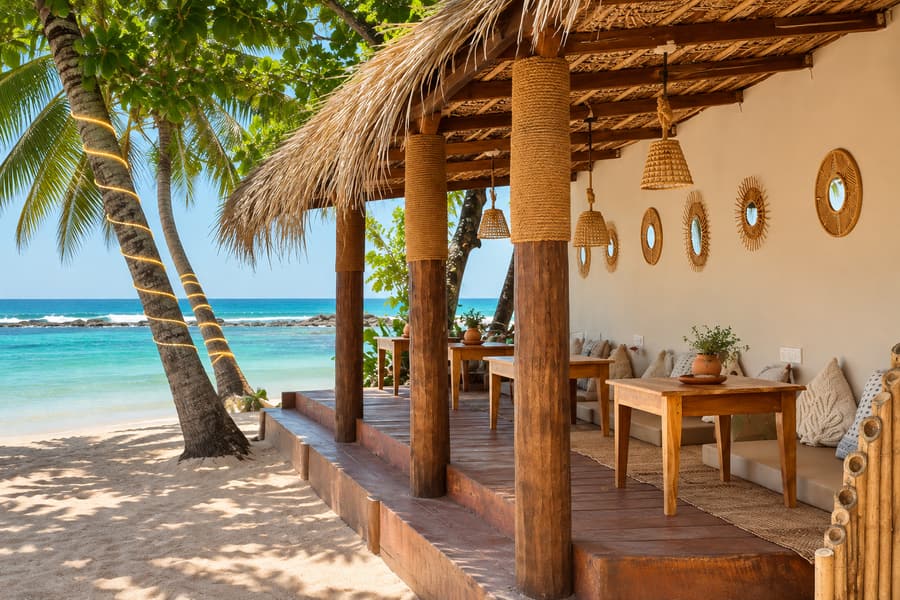
Our classes are at the Ohana Shala, the open upper floor of our restaurant at Turtle Beach, facing the ocean. A regular class is 4,000 LKR, and residents join for 3,000 LKR. Nat teaches our yoga. The days and hours are being set anew, so they are on our events page.
- Hatha Yoga. The slow one.
- Vinyasa Flow. The moving one. One of them is "Vinyasa for the Street Dogs", our charity class, and 100% of contributions go to two street-dog charities, WECare Worldwide and The Dziko Project.
- Slow Flow Yoga. The movement of vinyasa at a gentler speed.
- Yin Yang Yoga. Half active, half still.
- Yin Yoga and Sound, and Somatic Yin and Sound. Long holds on the floor, with sound while you rest. We explain that part in sound healing explained.
Each of our classes is described in yoga in Dikwella, and the classes are on the page of our yoga shala in Dikwella, near Hiriketiya. If you would like the class and breakfast as one thing, the Move & Brunch pass is on our passes page.
Good to know
- Regular classes cost 4,000 LKR. Residents join for 3,000 LKR.
- Mats are provided, and classes do not run in heavy rain. The days and hours are on our events page.
- Join any activity and you get 10% off the whole restaurant menu.
- Breakfast is served from 08:00 to 11:00. Filtered water is on the house.
- We are at Turtle Beach, Dikwella, less than five minutes by road from Hiriketiya.